
Bubble, Bubbles, Foam
November 18, 2013 The bubble pipe was a popular child's toy of my generation. but its popularity has waned along with that of candy cigarettes. A less offensive option is the simple wire (now plastic) loop found in the same jar as the bubble liquid. My first chemistry experience was the attempt to replicate the bubble liquid formulation with household chemicals when the jar's original contents were depleted. Alas, dish soaps of that era were not as good as those today, so my experiments were not the successful.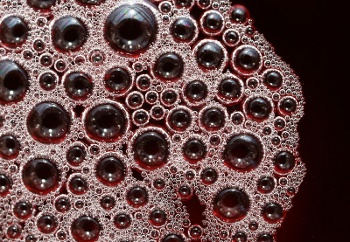 | All one shape, but many sizes. A foam of bubbles on a liquid. Photograph by Friedrich Böhringer, via Wikimedia Commons. |

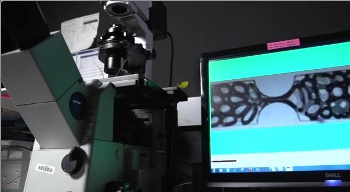 | Imaging apparatus for the study of bubble dynamics in a microfluidic channel. (Still image from a YouTube Video.[5]) |
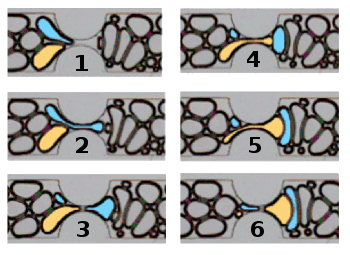 | A bubble is split as it enters a microfluidic channel while squeezed between a neighboring bubble and a wall. (Biswal Lab/Rice University image, modified for clarity.[4]) |

"We're trying to understand how foam behaves in porous media because it is a way of making gas act like a more viscous fluid... Normally, gas has very low viscosity and it tends to flow through rock and not displace oil and water. Once it finds a path, usually along the top of a reservoir, the rest of the gas tends to follow. If there were some way to make gas act more like a liquid, to make it more viscous, then it would contact much more of the reservoir and would push the fluids out."[4]This research was funded by various agencies, including the Petroleum Institute of the United Arab Emirates and the U.S. Department of Energy.[4] In my experience, beer, while technically a depressant, is a good stimulant for conversations about physics, and everyone has observed beer foam. Since most beer is today purchased in cans, not bottles, few observe an interesting beer foam effect which is the topic of entry no. V102302 in the American Physical Society Division of Fluid Dynamics Gallery of Fluid Motion 2013.[6-7] As shown in the photograph, tapping one beer bottle vertically with another will result in a beer foam fountain.[6]
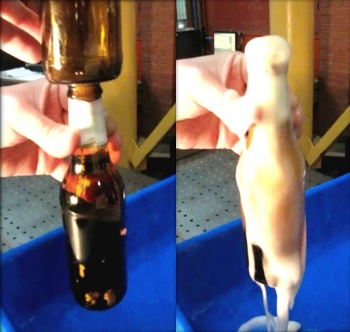 | Making a beer foam fountain. Step 1. - Tap an opened bottle at its top with another bottle. Step 2. - Observe fountain. (From a video by Javier Rodríguez-Rodríguez, Almudena Casado and Daniel Fuster, via arXiv.[6]) |
References:
- B. Würsig, C.R. Greene Jr. and T.A. Jefferson, "Development of an air bubble curtain to reduce underwater noise of percussive piling," Marine Environmental Research, vol. 49, no. 1 (February,2000), pp. 79-93.
- Kevin M. Lee, Kevin T. Hinojosa, Mark S. Wochner. Theodore F. Argo IV and Preston S. Wilson, "Using bubbles to reduce underwater noise," Paper 2aUWb11 of the 161st Meeting of the Acoustical Society of America, May 24, 2011.
- Rachel Liontas, Kun Ma, George J. Hirasaki and Sibani Lisa Biswal, "Neighbor-induced bubble pinch-off: novel mechanisms of in situ foam generation in microfluidic channels," Soft Matter, (Advance Article, September 16, 2013), DOI: 10.1039/C3SM51605A.
- Mike Williams, "Clues to foam formation could help find oil," Rice University Press Release, October 8, 2013.
- Rice University researchers observe two novel ways bubbles form in foam using a high-speed camera, YouTube Video, October 8, 2013.
- Javier Rodríguez-Rodríguez, Almudena Casado and Daniel Fuster, "Why does a beer bottle foam up after a sudden impact on its mouth?" arXiv Preprint Server, October 14, 2013.
- Colin Schultz, "The In-Depth Science of Why a Beer Bottle Erupts When You Whack It," Smithsonian, October 23, 2013.
- Kevin M. Lee, Kevin T. Hinojosa, Mark S. Wochner. Theodore F. Argo IV and Preston S. Wilson, "Using bubbles to reduce underwater noise," Paper 2aUWb11 of the 161st Meeting of the Acoustical Society of America, May 24, 2011.